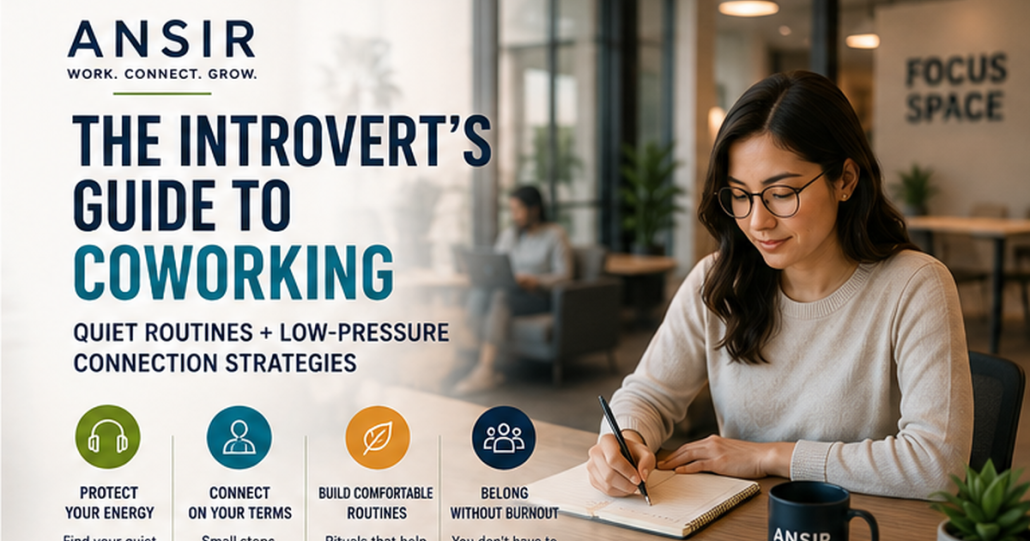
Coworking can be energizing, but if you are an introvert, it can also feel like a lot. New people, open space, events, conversations, and background energy can be helpful—or draining—depending on how you use the space.
The good news: you do not have to become the loudest person in the room to get value from coworking. You can build a routine that protects your energy while still creating useful connections over time.
First: coworking does not have to mean constant networking
One of the biggest myths about coworking is that you have to be “on” all the time. You do not.
The best coworking routine for introverts usually includes both:
- Quiet focus time for deep work
- Small, intentional connection that does not feel forced
You can use the space on your own terms.
1. Build an arrival routine
Arriving with a routine lowers the mental friction of entering a shared space.
Try this simple 5-minute routine
- Choose a seat that feels comfortable
- Set up your laptop, water, and notes
- Write your top priority for the session
- Put on headphones if you want a focus signal
- Start with one easy task to build momentum
Once your routine is familiar, the space starts to feel easier.
2. Use headphones as a boundary
Headphones are a simple, socially accepted way to signal focus. You do not need to apologize for using them.
A good rhythm is:
- Headphones on: focus mode
- Headphones off: open to light conversation
- Break area: low-pressure interaction zone
This gives you more control over when you are available.
3. Pick one low-pressure connection habit
You do not need to introduce yourself to everyone. Choose one small habit you can repeat.
Easy options
- Say hello to one person when you arrive
- Ask one person what they are working on
- Attend one event per month
- Ask a staff member for one relevant introduction
- Follow up with one person you already met
Small connection habits compound without draining your energy.
4. Use scripts so you do not have to improvise
Simple scripts remove pressure.
Conversation starters
- “Are you usually here on this day?”
- “What kind of work are you doing today?”
- “Have you been to any Ansir events you liked?”
- “I’m trying to get more consistent with coworking—what days do you usually come in?”
Easy exit lines
- “Nice talking with you. I’m going to jump back into work.”
- “I’m going to refill my coffee, but good to meet you.”
- “Hope you have a productive day.”
Being prepared makes conversation feel less awkward.
5. Choose events with structure
Unstructured networking can feel exhausting. Structured events are often easier because the format gives everyone a reason to talk.
Look for:
- Workshops
- Small meetups
- Panels with Q&A
- Topic-based coworking sessions
- Founder or freelancer roundtables
You can attend, listen, and participate when you are ready.
6. Protect recovery time
If you attend an event or have several conversations, build in recovery time afterward. That might mean a quiet work block, a short walk, or ending the day a little earlier.
Energy management is not avoidance. It is how you stay consistent.
7. Let familiarity do the work
The biggest advantage of coworking is repeated proximity. You do not need to force deep relationships quickly. When you show up regularly, people become familiar.
Over time, a simple “hey” becomes a conversation. A conversation becomes a coffee. A coffee becomes a collaboration, referral, or friendship.
A simple introvert-friendly coworking plan
- Pick 1–2 consistent days to come in
- Start with a 90-minute focus block
- Say hello to one person
- Attend one structured event per month
- Leave before you feel completely drained
Final takeaway
Coworking can work beautifully for introverts when it is built around quiet routines and low-pressure connection. You do not have to network aggressively. You just have to show up, protect your energy, and create small moments of connection over time.
That is enough.