Working from coffee shops can be fun. It’s flexible, the vibe can be energizing, and sometimes it’s exactly what you need to get out of the house.
But if you’re trying to build consistent momentum—especially as a founder, freelancer, or remote professional—there’s a point where coffee shops stop being a “workspace” and start being a productivity tax.
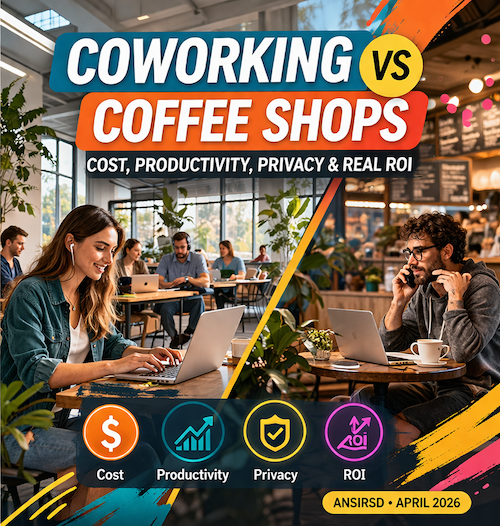
Here’s a practical comparison of coworking vs. coffee shops across cost, focus, privacy, and real ROI.
1) Cost: the “cheap” option isn’t always cheap
Coffee shops feel inexpensive because you pay in small amounts. But it adds up fast.
Typical coffee shop costs
- Drink + tip: $6–$10
- Snack/food (often happens): $8–$15
- Parking/time overhead: varies
If you do coffee shops 3–4x/week, you can easily spend $250–$500/month without realizing it.
Coworking cost is upfront—and predictable
Coworking is a consistent monthly investment, which makes it easier to budget and evaluate.
2) Productivity: focus is the real ROI lever
Productivity isn’t about being “busy.” It’s about doing the work that matters—especially the hard, high-impact tasks.
Where coffee shops help
- Light tasks (email, admin, outlining)
- A mood change when you feel stuck
- Short sessions when you don’t need calls
Where coffee shops often hurt
- Unpredictable noise and seating
- Interruptions and distractions
- Limited ability to take calls or meet clients
- “I should buy something else” pressure
Coworking tends to win on repeatable focus—because the space is designed for work, not turnover.
3) Privacy: can you actually work on sensitive things?
If you handle client work, contracts, proposals, financials, HR topics, or anything confidential, coffee shops can be risky.
Coffee shop limitations
- Shoulder-surfing (screens visible)
- Loud calls or sensitive conversations aren’t appropriate
- Public Wi-Fi risk (even when “fine,” it’s still public)
Coworking advantages
- Quieter zones designed for focus
- Better meeting options for calls and collaboration
- More professional setting for client conversations
4) Meetings and collaboration: “Can I show up professionally?”
When it matters, environment matters.
- Coffee shops: casual, unpredictable, and not always meeting-friendly
- Coworking: professional vibe, easier intros, and better for quick collaborations
If you’re building relationships, coworking naturally creates more high-quality interactions.
5) Consistency: routines are easier in a real workspace
Most people don’t need more motivation. They need a routine that reduces decision fatigue.
Coworking makes routines easier because:
- You show up and your brain switches into work mode
- You’re surrounded by other people doing focused work
- It’s easier to keep consistent days/hours
6) The simple ROI calculation (use this)
Try this simple equation:
Monthly ROI = (Hours saved × Your hourly value) + Value of opportunities created − Cost
Example
- Coworking costs: $300/month
- You save: 6 hours/month by focusing better
- Your time value: $75/hour
Value = 6 × $75 = $450 → ROI already positive, before you count any new opportunities or introductions.
When coffee shops are the right choice
Coffee shops are great when:
- You need a short change of scenery
- You’re doing light work, not deep focus
- You don’t need calls, privacy, or meeting space
When coworking is the smarter move
Coworking tends to win when:
- You need consistent focus
- You do client work or sensitive work
- You want a professional environment for calls/meetings
- You want community and collaboration to happen naturally
Final takeaway
Coffee shops can be a great occasional tool. Coworking is a system. If you’re aiming for consistent progress and real momentum, a workspace designed for work usually pays for itself faster than you expect.