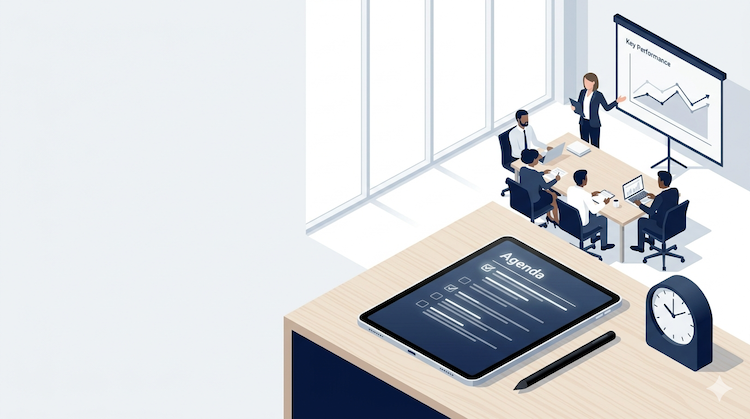
Most meetings don’t fail because people are unmotivated. They fail because the meeting has no clear purpose, no structure, and no decision at the end.
This post gives you a simple agenda template you can reuse for almost any meeting—plus facilitation habits that keep things moving without being awkward or overly “corporate.”
The 3 questions every meeting must answer
Before you schedule a meeting, answer these:
- Why are we meeting? (inform, decide, plan, unblock)
- What outcome will we leave with? (a decision, a plan, owners)
- Who must be there? (only the people needed for the outcome)
If you can’t answer these in one sentence, it’s probably an email, Loom, or Slack message.
A lightweight meeting agenda template (copy/paste)
Use this as your default agenda for 30–60 minute meetings.
Meeting Title
- Purpose: (one sentence)
- Desired outcome: (decision / plan / list of next steps)
- Pre-work (optional): (link + “please review before”)
0:00–0:05 — Context + goal
- Confirm the purpose and outcome
- Confirm timebox and end time
0:05–0:15 — Updates (only what’s needed)
- What changed since last time?
- What’s the key constraint or risk?
0:15–0:45 — Discussion (timeboxed topics)
- Topic 1: (10 min) → decision needed?
- Topic 2: (10 min) → options + tradeoffs
- Topic 3: (10 min) → next step(s)
0:45–0:55 — Decisions + next actions
- Decision(s): (what we decided)
- Actions: (owner + due date)
0:55–1:00 — Recap + close
- Quick recap of what’s being done, by who, by when
- Confirm next check-in (if needed)
Facilitation tips that actually work
1) Start with the “one sentence” goal
Say it out loud: “Today we’re here to ____ and leave with ____.” It prevents drifting.
2) Use timeboxes (and protect them)
If a topic runs long, you have three choices:
- Extend the meeting (rare)
- Decide with the info you have
- Assign an owner to follow up offline
3) Make decisions explicit
Don’t assume people “got it.” Say:
- “Decision check: are we aligned on option A?”
- “Any strong objections?”
- “Cool—then we’re deciding A.”
4) Capture actions live
Write action items where everyone can see them (doc, notes, whiteboard). Every action needs:
- Owner
- Due date
- Definition of done (one sentence)
5) End early when you can
Ending early is one of the best “culture signals” you can send. It tells people you respect their time.
Common meeting types and what they’re for
- Weekly check-in: unblock + align priorities
- Project meeting: decisions + next steps
- Client meeting: clarify scope + confirm deliverables
- Partnership meeting: define value exchange + next move
A quick rule of thumb
If your meeting doesn’t end with decisions or owners, it didn’t really happen—it just consumed time.
Try the template above for your next meeting and see how quickly your “meeting load” turns into real progress.