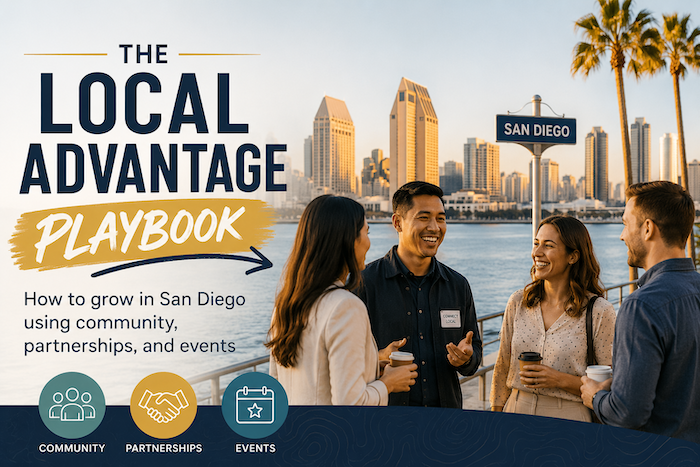
Online growth strategies are everywhere—ads, SEO, content, cold outreach. They work. But there’s a powerful advantage many founders and small teams underuse:
Local momentum. In a city like San Diego, relationships compound quickly when you show up consistently and create real value for people nearby.
This playbook is a practical, local-first approach to growth using community, partnerships, and events—the kind of strategy that builds pipeline and long-term reputation.
The core idea: proximity makes trust easier
Local growth works because:
- People can meet you in real life (higher trust)
- Introductions happen faster (shared networks)
- Partnerships are easier to test (quick feedback loops)
- Consistency stands out (most people don’t show up repeatedly)
Part 1: Community — become “known” in one lane
The biggest mistake people make locally is trying to meet everyone. Instead, pick one lane where your ideal customers and partners already gather.
Pick your lane (examples)
- Founders and operators
- Creators and marketers
- Tech / product / data
- Real estate / hospitality
- Health, wellness, or service businesses
Your community rhythm (simple and realistic)
- Weekly: one helpful post or share + one intro
- Monthly: attend one event
- Quarterly: host something small (workshop, roundtable, cowork day)
Being consistent matters more than being everywhere.
Part 2: Partnerships — trade value, not vibes
Good partnerships have a clear value exchange. Ask: What do I provide that helps them, and what do they provide that helps me?
High-leverage partnership types
- Referral partners: adjacent service providers who share your audience
- Content partners: co-create a workshop, webinar, or local guide
- Distribution partners: communities/newsletters that can share your offer
- Venue partners: spaces that host your events or gatherings
A simple partnership pitch (copy/paste)
“Hey [Name]—I work with [who] on [result]. I think there’s overlap with your audience. Want to try a small collaboration (one event / one co-post / one referral swap) and see if it creates value?”
Keep it small. Make it easy to say yes.
Part 3: Events — show up with an outcome
Events become powerful when you stop going “just to network” and start going with a small goal.
Event goals that work
- Meet 2 people in your lane
- Have 1 quality conversation about a real problem
- Leave with 1 follow-up scheduled
The best follow-up message (short and normal)
“Great meeting you at You are not allowed to view this event.. If you’re open to it, I’d love to continue the conversation—want to grab coffee or do a quick 15-minute call next week?”
Make it measurable: a local growth scoreboard
Track just a few numbers each month:
- Events attended: ___
- New conversations: ___
- Follow-ups scheduled: ___
- Introductions made: ___
- Opportunities created: ___
If you track it, you’ll improve it.
The “Local Advantage” weekly plan (30 minutes total)
- 10 minutes: reach out to one potential partner
- 10 minutes: follow up with one person you met recently
- 10 minutes: share one helpful insight publicly (LinkedIn, newsletter, community post)
This isn’t flashy—but it compounds fast.
Why coworking helps local growth
Coworking spaces aren’t just desks. They’re a local growth engine because they create:
- Repeated proximity to people building things
- Easy introductions and collaboration
- Events that lower the friction of meeting the right people
- A consistent “home base” for your professional identity
Final takeaway
If you want to grow in San Diego, don’t rely only on online tactics. Use the local advantage: show up consistently, build a few real partnerships, and treat events like a system—not a random outing.
That’s how community turns into opportunities.